
After leaving my company and experiencing life outside the corporate environment, I noticed something surprising. Stores would retroactively credit points I had forgotten, I could easily get what I needed at drugstores, and bakeries provided freshly baked bread with a smile.
“I didn’t realize the world could be so accommodating.”
At the same time, a question arose. Why did so many of the high-income employees (earning around ¥10,000,000, roughly $73,000 USD) at my former company display such rigid or “twisted” personalities?
You may have heard the saying, “Happiness declines once you earn more than ¥6,000,000.” While there is room for debate, within the framework of Japanese corporate life, this seems largely accurate.
But why does higher income sometimes lead to lower happiness and personality distortions? Let’s look at it as a structural issue rather than an individual flaw.
Note: This is a general perspective organized by me with AI. Individual experiences may vary.
Evaluated by “Your Boss,” Not Your Results
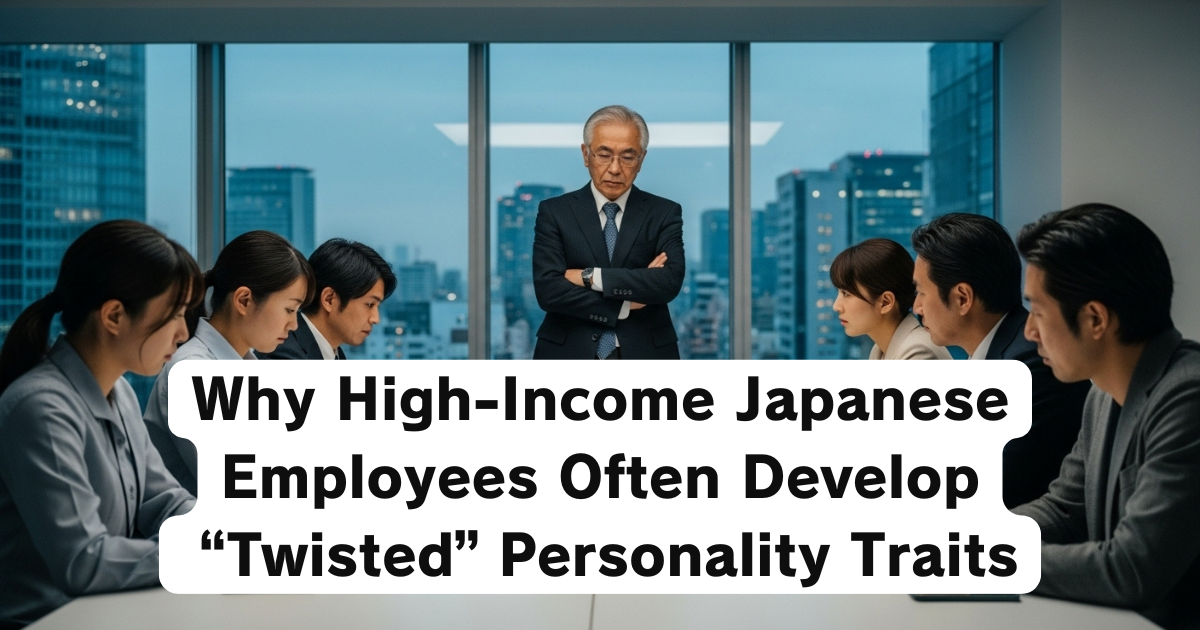
A defining feature of Japanese corporate life is that performance evaluation is based not on customers or consumers, but on the subjective perception of specific managers.
No matter how correct your decisions are or how much results you produce, the final evaluation depends on “what the boss thinks.”
In this structure:
- Logic is less important than office atmosphere
- Results matter less than impression
- Correctness is secondary to political navigation
Consequently, twisting your thoughts and feelings becomes a rational survival strategy.
Living With the Constant Fear of Falling
Employees earning around ¥10,000,000 (~$73,000 USD) may appear like winners on the surface. But internally, they constantly fear:
- Losing their position could mean a drop in lifestyle
- Losing their role could make them feel invisible
- Next, it could be me
In this environment:
- Political skills outweigh raw ability
- Faction alignment matters more than results
- Only those who survive this system persist
The final survivors are often those who can adapt their personalities to cope. This produces:
- The illusion of being “chosen”
- Arrogant or dismissive attitudes toward others
- Aggressive communication styles
High Income = Endurance
Many companies operate on the unspoken principle that “high earners should endure.”
- Transfer requests are rarely approved
- Desired skills rarely align with assigned work
- Corporate priorities outweigh personal fulfillment
- High income and meaningful work are rarely balanced by design
The result:
- Money exists, but satisfaction does not
- Freedom is limited, while responsibility is high
External Pressures Amplify Stress
External changes intensify the pressure:
- Shrinking domestic markets
- Increased need for overseas expansion
- International competition where personal relationships are less effective
- Rapidly changing skill requirements due to AI and technology
Traditional corporate practices no longer guarantee security, while expectations remain high.
Employment Shifts and Cost Pressures
Recent changes in Japan’s labor environment include:
- Equal pay for equal work between contract and regular employees
- Wage increase requests
- Shareholder demands for efficiency
Even large companies cannot meet all demands fully. Adjustments are inevitable.
High-income employees are high-cost fixed expenses. In practice:
- The same work can often be outsourced for less
- Benefits and insurance add to the company’s total cost
As a result, “quiet adjustments,” such as early retirement for employees in their 40s, are occurring.
Why High-Income Employees’ Personalities Distort (Summary)
The pressures on ¥10,000,000 (~$73,000 USD) earners in Japanese companies include:
- Subjective evaluation
- Constant fear of losing status
- Lifestyle tied to employment
- High income = endurance mindset
- Exposure to external market changes
- Being a high-cost resource for the company
This is less about individual weakness and more about structural realities of Japanese corporate life.
Characteristics of Employees Who Resist Distortion
Some high-income employees maintain a healthy personality. Common traits include:
- Having evaluation metrics outside the company
- Keeping lifestyle expectations reasonable
- Possessing skills independent of office politics
- Not equating their life entirely with their company
In short, they maintain appropriate distance from the corporate environment.
Conclusion
High income (¥10,000,000 / ~$73,000 USD) is not a guarantee of happiness. Without understanding the structural context, reaching this income level can be exhausting.
Whether a high income distorts personality depends less on the number itself, and more on:
- How the income is received within the corporate structure
- How emotionally and professionally independent the employee is
People are strongly influenced by the environment and social context they engage with. Considering this is crucial when assessing the “success” of high-income Japanese employees—especially in a country where currency depreciation and rising living costs make even ¥10,000,000 a challenging income.

コメント