
Overview
This morning, Japanese news reported that the government-backed “Bank Stock Purchase Program” (Banking Institution Stock Acquisition Corporation), which has been buying back banks’ “relationship stocks,” will no longer make new purchases.
In simple terms, banks have traditionally held certain shares of client companies not for profit, but to maintain business relationships and corporate stability. When banks wanted to reduce these holdings, this government-supported program provided a safe buyer. From now on, that safety net is no longer available.
This article explains what these “policy shares” are, why they existed, and how stopping the buyback program could affect companies, investors, and workers.

1. What Are Policy or “Relationship” Stocks?
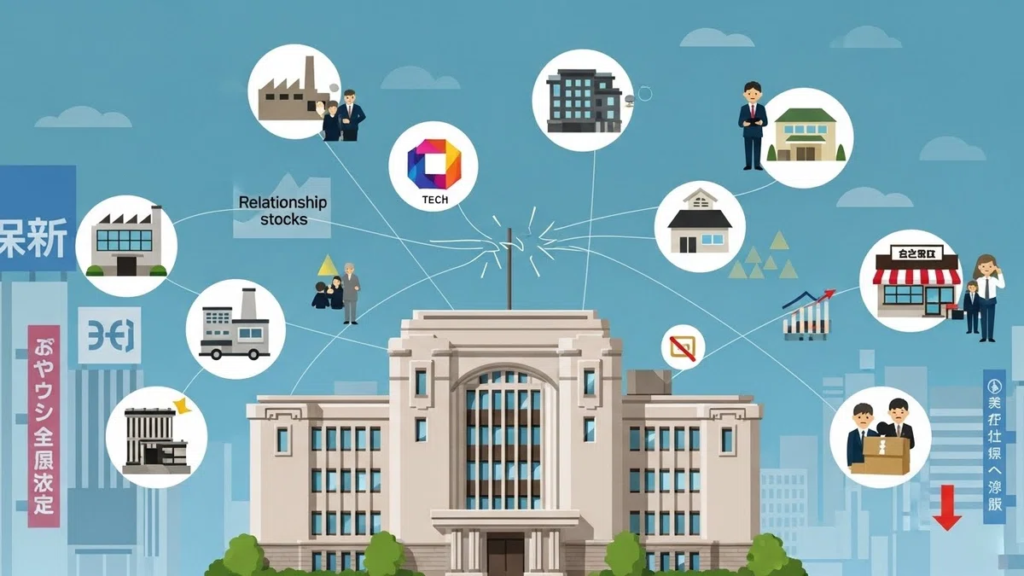
Policy shares are stocks held by banks or companies not for financial gain, but to maintain business relationships and corporate stability.
Characteristics:
- Held long-term
- Not sensitive to short-term stock price fluctuations
- Do not impose strict demands on company management
For companies, these shares served as “stable shareholders that reduce market pressure,” allowing management to focus on long-term strategy rather than reacting to short-term investor demands.
2. Why Did Relationship Stocks Exist?
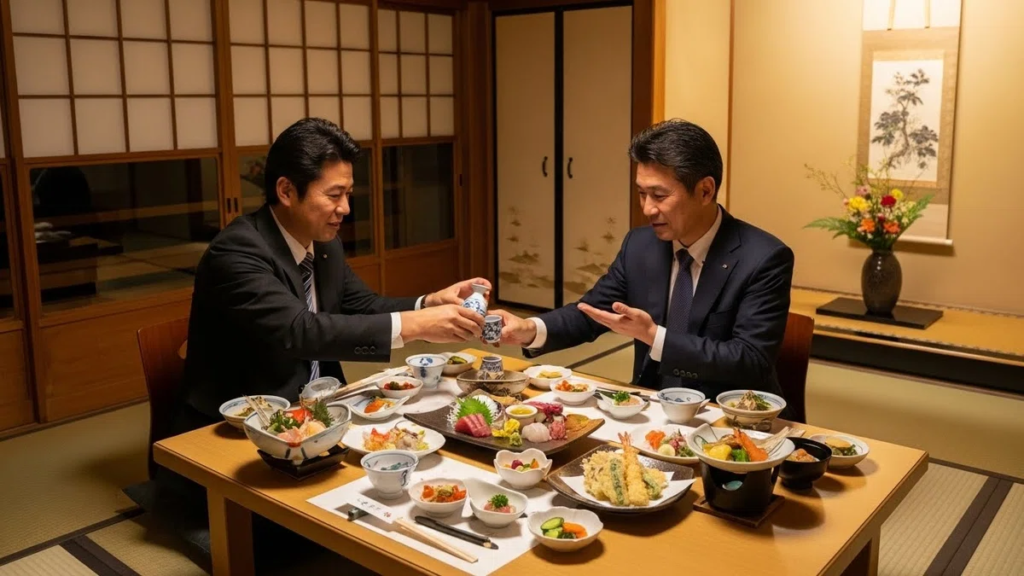
Two main mechanisms supported this practice:
① Stable Shareholders
Banks or business partners holding these stocks would not sell quickly, even if the company’s performance dipped, dividends were reduced, or management reforms were delayed.
→ Companies could avoid short-term market pressures and activist investor interventions.
② The Bank Stock Purchase Program as a “Safe Exit”
Banks also had a fallback: the government-backed acquisition program would buy their policy shares in bulk if needed, avoiding market disruption.
Key point:
Stable shareholders × Safe exit = Support for Japan’s traditional corporate management.
3. What Changes with the Buyback Halt?

The government has decided not to extend new purchases under the program, which will have several consequences:
For Banks:
- New relationship stock holdings will mostly stop
- Existing holdings will be reduced gradually
- Stocks that cannot be justified as necessary will be harder to keep
→ Holding policy shares becomes a risk.
For Companies:
- The assumption “banks will hold shares, so we are safe” no longer holds
- Shareholder base will shift to institutional investors, overseas investors, and individual shareholders
4. Impacts on Companies

Public Companies:
- Increased accountability to shareholders
- Greater focus on capital efficiency, profitability, stock price, and dividends
- Restructuring of low-performing business units, subsidiaries, or non-core operations
Recent trends such as the closure of subsidiaries and early retirement programs fit into this shift.
Human Resources & Employment:
- Shareholder pressure affects personnel costs and organizational structures
- Systems based on lifetime employment and seniority are increasingly challenged
- Companies may implement:
- Staff reductions including subsidiaries
- Early retirement programs
- Skill- and performance-based evaluations
Private Companies:
- Even non-listed companies will see loans and relationships evaluated more on business performance and profitability rather than long-standing ties
- Increased need for transparency and financial discipline
5. Impacts on Investors
- Investors gain more influence over management decisions
- Companies must focus on capital efficiency, dividends, and profitability
- Market-driven oversight may correct the traditional “soft management” practices in Japanese companies
→ Positive for investors, increases transparency of Japanese stock market
6. Impacts on Workers & Consumers

Does this mean the end of lifetime employment?
- Not directly
- Indirect pressures will grow: profits, personnel costs, and business selection will be more closely monitored
- Results may include:
- Restructuring of underperforming units
- Revisions to seniority-based systems
- Emphasis on skills, expertise, and performance
Outcome:
Lifetime employment may no longer be universally guaranteed, while individual skills, marketability, and career mobility become more important.
7. Summary

- Policy shares served as a “buffer against market pressure.”
- With the buyback program ending, this buffer is reduced
- Companies can no longer ignore investors
- Positive for investors
- For workers and consumers, stability may decline, while competition and performance-based evaluation increase
- This move signals a quiet but significant shift in Japanese corporate culture, marking a step toward more market-driven governance and performance-focused management.

コメント