
When observing Japanese companies, you may notice something puzzling.
Executives talk enthusiastically about new businesses and growth, yet quietly, people and projects seem to disappear.
The company speaks of innovation, but the atmosphere feels cautious.
This is not necessarily confusion or poor management.
In many cases, it reflects a uniquely Japanese “dual structure” in corporate decision-making.
What Is the “Dual Structure” in Japanese Companies?
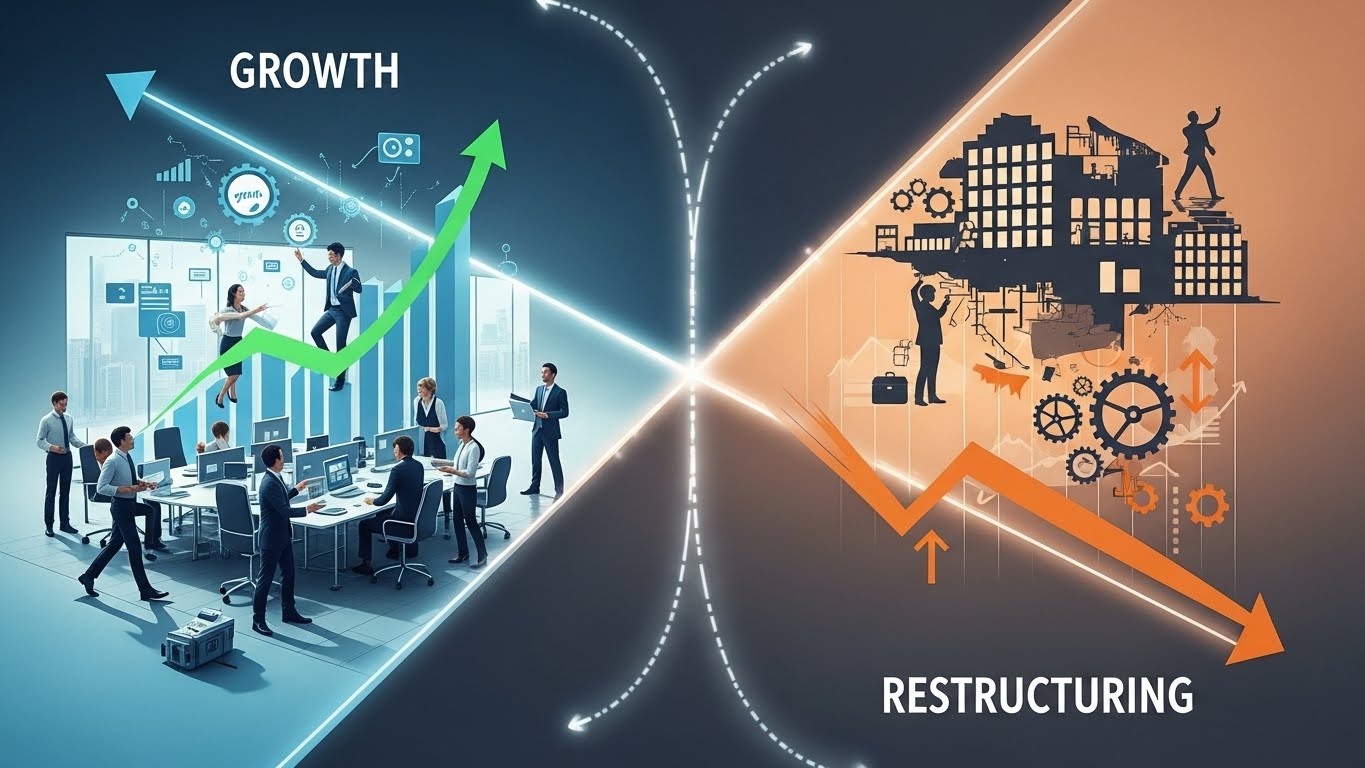
In this context, “dual structure” means that two directions move forward simultaneously:
On the surface (Tatemae — public stance):
- Growth
- Reform
- New business initiatives
- Challenges and innovation
Behind the scenes (Honne — underlying intention):
- Restructuring
- Withdrawal from unprofitable areas
- Risk management
- Loss minimization
Importantly, neither side is a lie.
Japanese companies often hold two intentions at the same time:
“We want to grow” and “We must not fail.”
As a result, optimistic messaging and quiet cleanup proceed in parallel.
Why Does This Dual Structure Emerge in Japan?

1. A Culture That Avoids Abrupt Direction Changes
Japanese corporate culture tends to:
- Avoid directly rejecting past decisions
- Avoid openly blaming individuals
- Avoid sudden strategic pivots
Instead of sharp turns, companies prefer gradual adjustments:
talking about growth publicly while refining or shrinking internally.
2. Difficulty in Explicitly Labeling Failure
Declaring “this business failed” is still culturally difficult in Japan.
Instead, companies signal change through:
- Budget reductions
- Personnel transfers
- Leadership replacement
- Quiet exits from projects
In other words, strategy shifts are often communicated through people, not words.
Where Does the Dual Structure Appear Most Clearly?
More than in financial statements, it appears in human placement and departures.
1. Growth Talk with Restructuring Experts in Key Roles
- Executives with liquidation or restructuring experience positioned close to the CEO
- Increasing influence of banking, finance, or risk-management backgrounds
This suggests the company is preparing for downside scenarios, even while pursuing growth.
2. Long-Tenured Internal Experts Quietly Leaving
Long-serving professionals often understand:
- Past successes
- Unspoken rules
- Management’s true priorities
When such people leave quietly, it may indicate the company has already entered a new phase.
Look Beyond Slogans: Watch Who Does What
In Japanese companies, strategy is often revealed less by:
- Vision statements
- CEO messages
- Mid-term plans
and more by:
- Who stays
- Who leaves
- Who is placed in critical roles
This is not immaturity.
It is a form of risk diversification that minimizes open conflict.
Another Key Signal: What Executives Are Studying

What top management chooses to learn often reveals future direction.
Growth-oriented signals
- Studying innovation, startups, DX, or global expansion
- Actively engaging with external experts
Downsizing-oriented signals
- Studying restructuring, M&A, governance, compliance
- Increasing discussions with lawyers and accountants
A dangerous signal
- Executives stop learning entirely
- Repeating past success stories
- Saying “We’ll be fine” too often
This may indicate stagnation rather than strategy.
Is the Dual Structure a Bad Thing?
Not necessarily.
It helps avoid:
- Reckless growth
- Overly conservative shrinkage
Japanese companies often try to run both paths simultaneously.
The real problem arises when employees and observers fail to read this structure.
Conclusion: A Small Lens to Understand Japanese Companies

When analyzing Japanese companies, try asking:
- Who is being positioned where?
- Who acts as the brake?
- Are departures really “personal reasons”?
In Japan, people move before strategy is spoken.
Understanding this dual structure offers a pow
Thanks for always supporting me! If you like my content, a cup of coffee’s worth of support would mean a lot.


コメント