Today, Yahoo! News reported a surprising development—iRobot, the company behind the Roomba, has filed for bankruptcy. Many of us who grew up with its products feel both shock and a sense of loss.
Using AI, we have compiled a detailed timeline of the company’s path to bankruptcy, along with the careers of its CEOs and insights drawn from the data. For more in-depth information that didn’t fit into the article, we have prepared downloadable content.
In today’s world, even well-known companies can fail. Understanding the warning signs of bankruptcy is crucial to take timely action. This material aims to provide useful insights for recognizing early signs of corporate crises at your own company or in your industry.
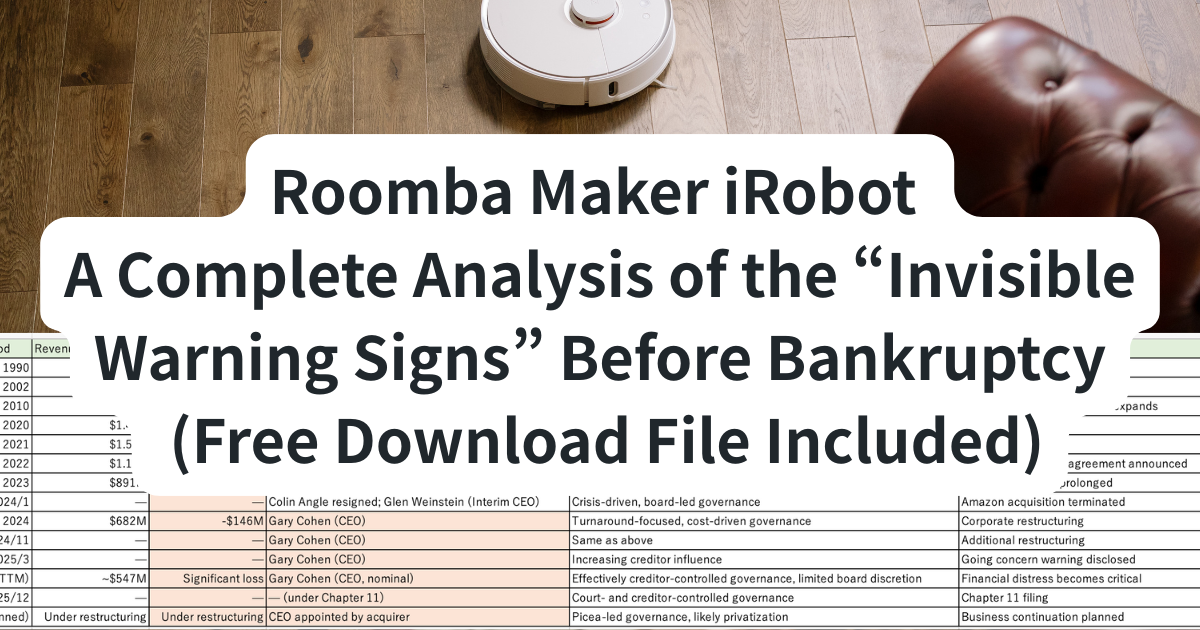
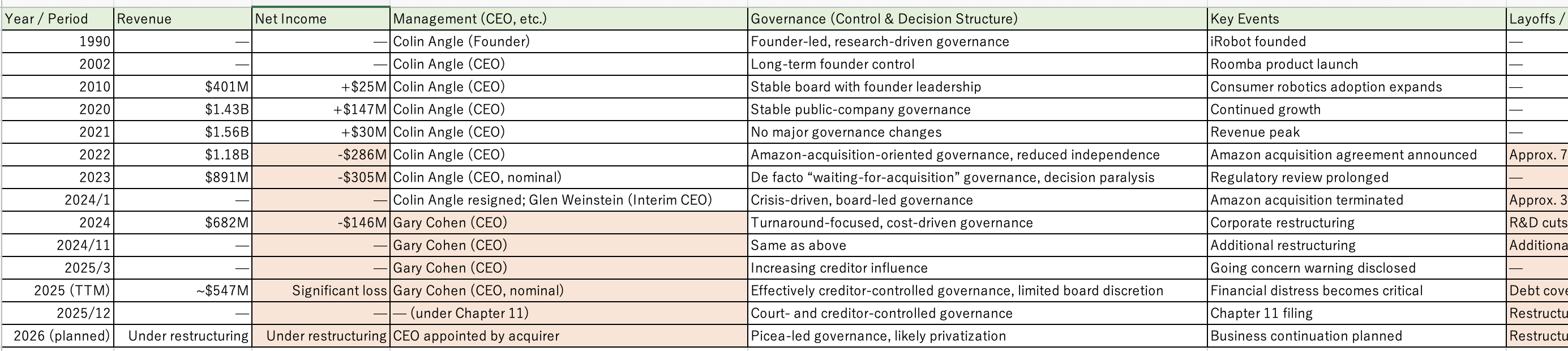
One of the most notable aspects of iRobot’s collapse is the gap between management and governance. From 2022 to 2023, founder Colin Angle remained CEO. However, real decision-making authority was effectively frozen under a governance structure dependent on a potential Amazon acquisition.
CEO Present but Powerless: What “Governance Freeze” Means Even though Angle was CEO, key company decisions barely moved. From 2022 onward, major investments and strategies required approval tied to the Amazon acquisition, leaving the internal decision-making almost paralyzed. In other words, the CEO’s position existed, but actual authority lay with external parties—either the acquiring company or regulators. This “governance freeze” made it nearly impossible to maneuver or delay the path toward bankruptcy.
2. Link Between Financial Decline, Layoffs, and Employee Sentiment
iRobot’s sales, profits, and employee feedback moved in near synchrony:
2021: Sales peak, strong performance
2022: Management dependent on Amazon acquisition
2024: Acquisition collapses, instability rises
2025: Trust erodes, bankruptcy filing
Declining revenue and rising losses coincided with increasing employee anxiety, showing a tight correlation between financial health and organizational morale.
3. Employee Reviews Highlight Structural Issues
Employee reviews consistently rated talent, technology, and corporate culture highly, but governance and decision-making received poor evaluations. This demonstrates that even strong teams and culture cannot fully offset risks from opaque leadership or unclear strategy.
Careers of Colin Angle and Gary Cohen
Colin Angle (Founder & Former CEO)
MIT Media Lab roboticist
Founded iRobot in 1990
Led commercialization of Roomba and other household robots
CEO for decades, directing product development and technical strategy
Gary Cohen (Restructuring CEO)
Timex CEO (2011–2013): global brand management and restructuring
Qualitor Automotive CEO (2015–2022): corporate turnaround and financial improvement
Joined iRobot as CEO in 2024 to focus on financial stabilization and business reorganization
Gary Cohen’s Appointment Signaled the Company’s Downward Path
Analysis of leadership change, subsequent layoffs, restructuring, employee reviews, and CEO backgrounds suggests Cohen’s role was that of a short-term “turnaround specialist”.
Colin Angle’s Departure Angle’s resignation came when external dependency (Amazon acquisition) and debt burden made autonomous management difficult. The CEO transition was more about preparing assets for external parties than saving the company.
Cohen’s Role Cohen executed short-term financial stabilization, cost-cutting, R&D reduction, and product line consolidation—essentially a “liquidation-style turnaround”. Long-term strategy or cultural rebuilding was minimal, leaving employee morale and brand attachment vulnerable.
Conclusion
By the time the founder stepped down and Cohen assumed leadership, iRobot’s path toward bankruptcy was effectively set. Cohen’s role was not to save the company, but to minimize losses and satisfy creditors and potential acquirers.
Summary
From the failed Amazon acquisition onward, iRobot’s management was effectively on a downward trajectory. Leadership changes, layoffs, and restructuring were warning signs. Employee reviews show that the information to anticipate the company’s collapse existed, but the governance freeze and information asymmetry made it difficult for employees to perceive the crisis.
iRobot’s case provides valuable lessons for recognizing early warning signs of corporate decline in your own company or industry.

 Colin Angle (Founder & Former CEO)
 Analysis of leadership change, subsequent layoffs, restructuring, employee reviews, and CEO backgrounds suggests Cohen’s role was that of a short-term “turnaround specialist”.
 From the failed Amazon acquisition onward, iRobot’s management was effectively on a downward trajectory. Leadership changes, layoffs, and restructuring were warning signs. Employee reviews show that the information to anticipate the company’s collapse existed, but the governance freeze and information asymmetry made it difficult for employees to perceive the crisis.
コメント